

12 Questions to Ask Before Buying a Handheld SLAM Scanner (FAQ)
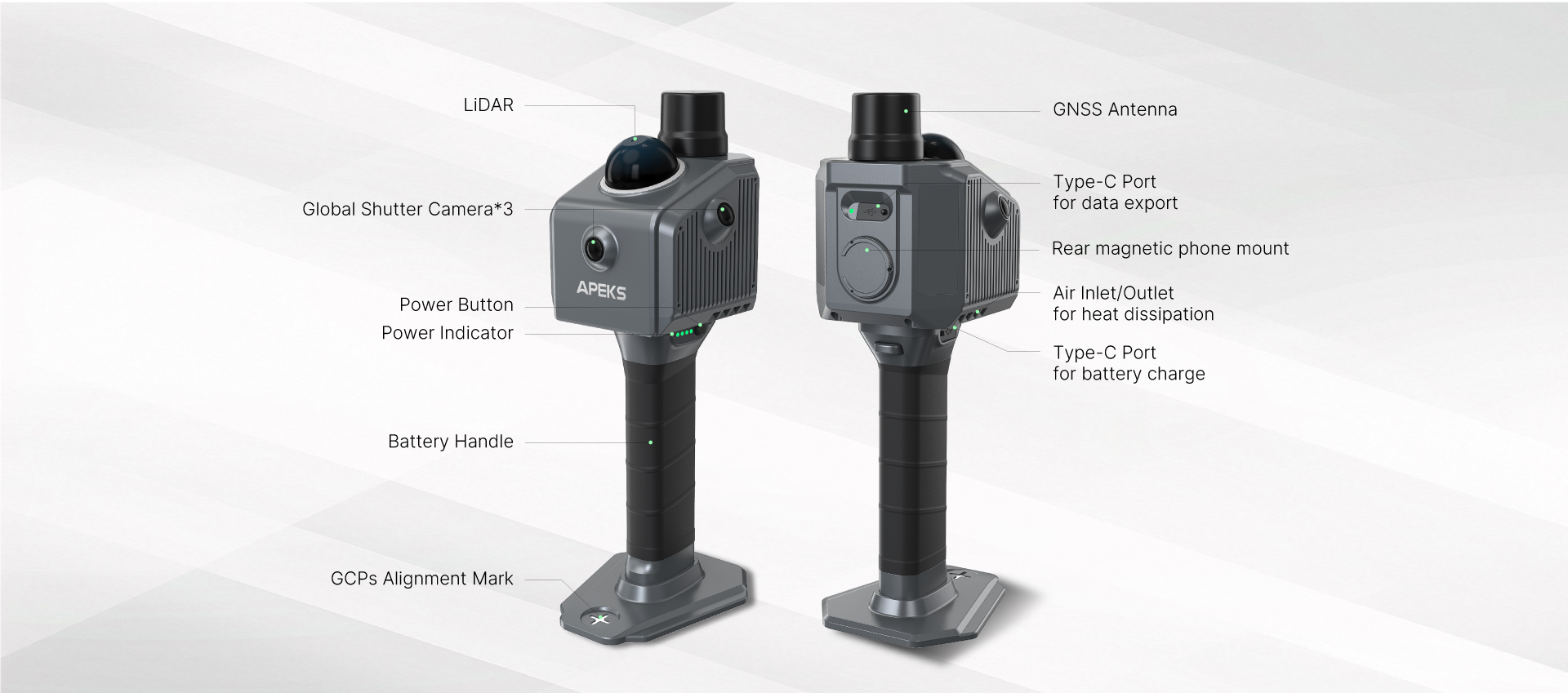
Every question in this guide maps to a line on the specification sheet — here, the AScan X1's hardware layout as a worked example.
Before buying a handheld SLAM scanner, ask twelve questions in four groups: capabilities (scan range at both reflectivity conditions, relative vs absolute accuracy, laser class, field of view), positioning (built-in GNSS RTK, GNSS-denied behavior, IMU), field practicality (weight, battery, environment rating, in-field quality checks), and data (export formats, storage and transfer). Any vendor that answers all twelve in writing is a vendor you can hold to a specification.
Why Ask Before You Buy
Handheld SLAM scanners are a crowded, fast-moving category, and marketing pages do not always volunteer the details that decide whether a unit fits your work. The fix is a fixed checklist: twelve questions, asked the same way of every vendor, with answers in writing.
This guide uses the AScan X1 — a SLAM scanner with built-in GNSS RTK — as a worked example, because every question below maps to a specific line of its official specification. Wherever you see a number, it comes from the official spec sheet; use the same discipline with any other brand's datasheet. (For a deeper conceptual grounding, start with our handheld SLAM LiDAR scanner explainer.)
One question we deliberately leave out: "how much does it cost?" — not because price does not matter, but because it deserves its own treatment, covered in our handheld SLAM LiDAR scanner price guide.
Capability Questions (Q1–Q4)
Q1. What is the scan range — and at what reflectivity?
Range numbers without conditions are marketing, not specification. Laser range depends on how much light the target returns, so the only honest way to quote range is at a defined reflectivity. Ask for both values. The AScan X1, for example, specifies a maximum measure range of 40 m @ 10% reflectivity / 70 m @ 80% reflectivity — the first figure describes dull, dark surfaces, the second bright ones. A datasheet that only prints the bigger number is telling you half the story.
Q2. Is the accuracy claim relative or absolute?
Relative accuracy describes how well points agree with each other inside one scan; absolute accuracy describes how the scan sits against true coordinates. A scanner can be excellent at the first and modest at the second. Ask for both, and ask under what conditions they hold. The AScan X1 specifies 1 cm relative accuracy and 5 cm absolute accuracy, under specified operating conditions — a written pair you can compare directly against your project tolerances.
Q3. What laser class is it, and where can it be operated?
Laser class governs eye safety for the operator and anyone nearby. The AScan X1 runs a Class 1 eye safe laser (905 nm wavelength) with 40 lines and a 200,000 points per second measure rate — Class 1 being the classification that permits operation without protective access restrictions around the beam path.
Q4. What does the scanner actually see — FOV and color?
Field of view determines how much geometry one pass captures, and cameras determine whether the point cloud arrives colorized. The AScan X1's laser FOV is 360° × 59°, and its three global shutter cameras (2 MP each) cover 300° (H) × 101° (V) to colorize the cloud. Ask for both fields of view separately — they are different sensors, and a combined headline number can hide a narrow vertical band.
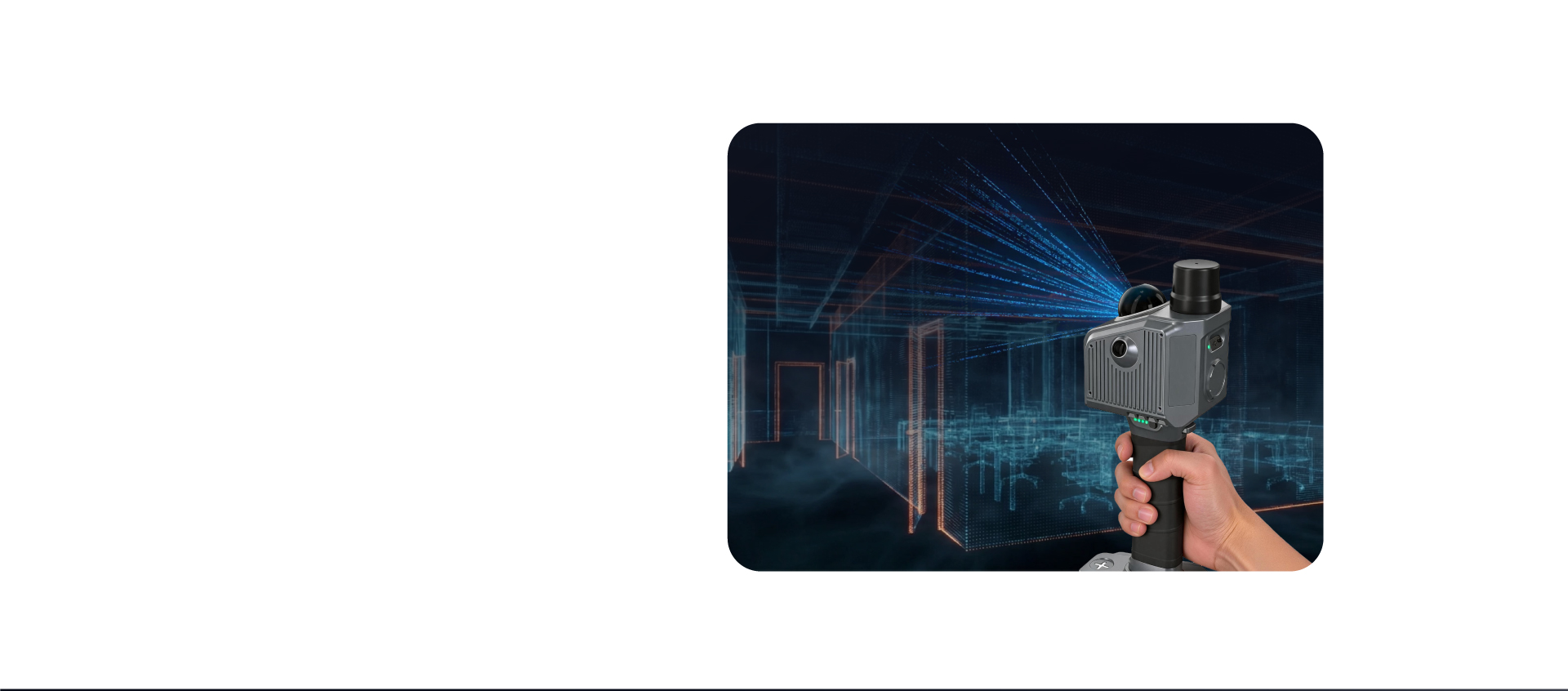
Indoors — where GNSS does not reach — SLAM carries the solution. Ask how the scanner behaves when the satellite signal disappears.
Positioning Questions (Q5–Q7)
Q5. Does it have built-in GNSS RTK for georeferencing?
A SLAM scan on its own is an internally consistent but locally-referenced point cloud. Built-in RTK changes the workflow: the same instrument that tracks the geometry also records its own precise position, so the cloud arrives georeferenced without a separate survey to tie it in. The AScan X1 is a SLAM scanner with built-in GNSS RTK — a 1408-channel GNSS receiver with RTK accuracy of H 8 mm + 1 ppm / V 15 mm + 1 ppm (RMS) — and our guide to the handheld SLAM scanner with built-in GNSS RTK explains why that integration changes field procedure.
Q6. What happens where GNSS does not reach?
Buildings, corridors and deep interiors are GNSS-denied environments, and this is precisely where SLAM earns its place: the scanner keeps solving its motion from the environment itself. Ask the vendor to describe this behavior explicitly — how long the scanner can hold a reliable track without satellite signal, and what it does when the sky becomes visible again. A vendor with a clear answer here has tested it.
Q7. What IMU is inside, and how is it used?
The inertial measurement unit bridges the gaps between laser frames and satellite fixes. The AScan X1 carries a high-precision IMU fused with its GNSS and SLAM solutions. Ask how the sensor fusion works at a level you can verify — which sensors contribute, and what the vendor claims about behavior during fast motion.
Field Practicality Questions (Q8–Q11)
Q8. What does it weigh in working configuration?
Handheld scanning means the instrument is in your hand for the whole capture session — so the honest weight question is "with the battery attached". The AScan X1 weighs 1.5 kg with battery handle. Compare working weights, not shipping weights.
Q9. How long does one battery last, and can I charge while working?
The AScan X1 runs about 2.5 hours per battery, charges via a Type-C port at 30 W, and supports simultaneous charging and operation — a detail that decides whether a wall socket extends your working day or just the waiting time between sessions. Ask whether batteries are swappable in the field.
Q10. What environment can it work in?
Dust, rain and temperature swings are field realities. The AScan X1 is rated IP64 (according to IEC 60529) with an operating temperature range of −10 °C to 40 °C. Match the ingress rating against your wettest, dustiest site — not against a showroom.
Q11. How do I check data quality while still on site?
Discovering a bad scan at the desk means a repeat trip. The AScan X1's APEKS-LIVE software provides data acquisition control and real-time point cloud display during capture, so coverage gaps show up while you can still walk back and rescan. Ask every vendor what their live view actually shows — full cloud, subsample, or a button that says "recording".
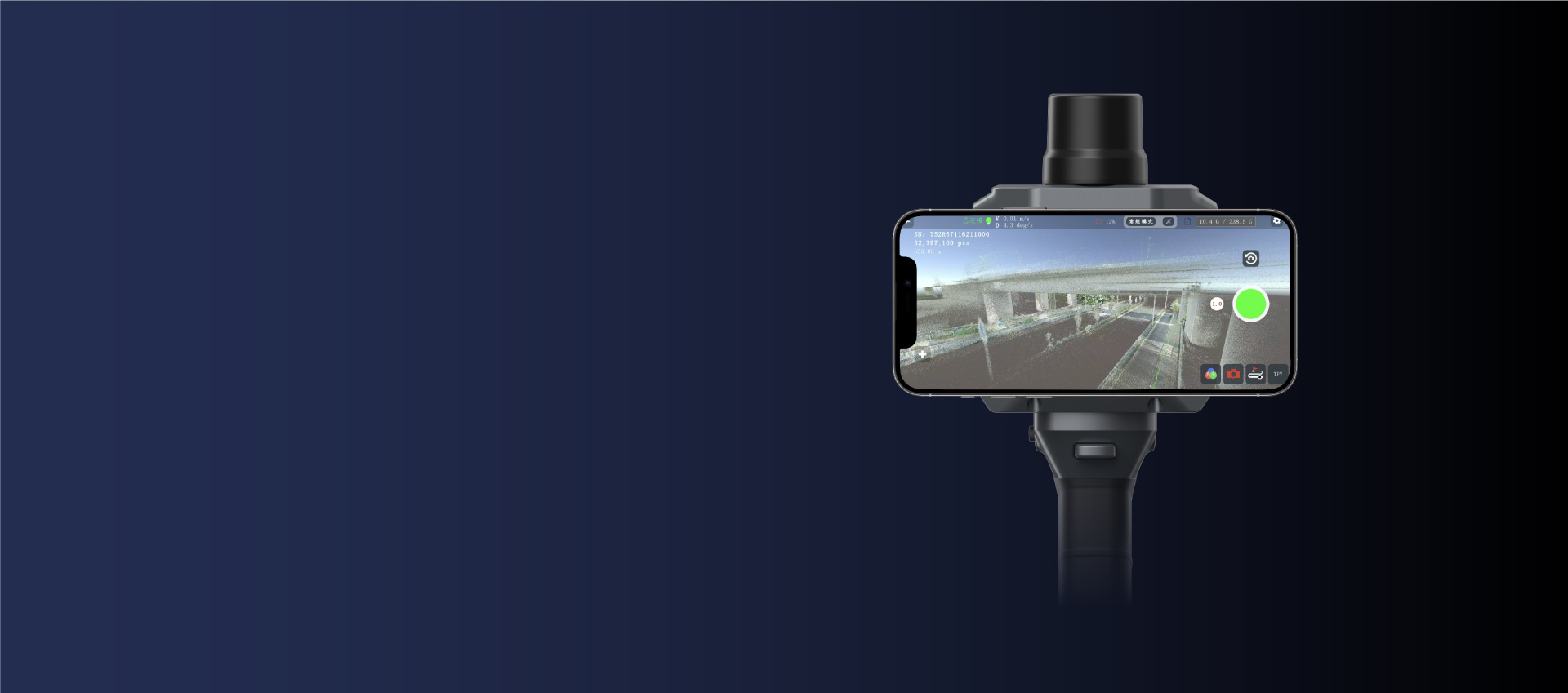
Real-time point cloud preview on a mounted phone: the difference between catching a coverage gap on site and discovering it at the desk.
Data & Deliverable Questions (Q12)
Q12. What formats does it export, and what storage does it carry?
Deliverables outlive the purchase decision, so formats deserve a written answer. The AScan X1 exports colorized point clouds in LAS, LAZ, E57 and PCD, and colorized mesh in PLY. Via APEKS-CORE post-processing, additional exports are available, including DXF for CAD workflows — the path from cloud to drawing is covered in our scan-to-CAD workflow guide, and what the formats mean for downstream software in our point cloud density, accuracy and formats deep dive. On hardware, the AScan X1 stores data on a built-in 256 GB SSD with USB 3.0 transfer — enough for a full day of capture, but ask how your session length translates to gigabytes before committing.
Two companion questions to close the checklist: what software is included (the AScan X1 ships with APEKS-LIVE for acquisition and APEKS-CORE for processing, with the software permanently activated), and how the answers to all twelve questions compare against the price — the subject of our price guide.
FAQ
What scan range does a handheld SLAM scanner need?
Match the range to your farthest legitimate target, and always ask for range at two reflectivity conditions — the honest specification quotes both. The AScan X1, for example, specifies 40 m @ 10% reflectivity / 70 m @ 80% reflectivity: the first covers dark, dull surfaces, the second bright ones. A datasheet that prints only the larger number is telling you half the story.
Can a handheld SLAM scanner work indoors without GNSS?
Yes — GNSS-denied environments are exactly where SLAM earns its place, because the scanner solves its motion from the environment itself. What you should ask the vendor is how long the scanner holds a reliable track without satellite signal and what happens when the sky becomes visible again. With a built-in GNSS RTK unit like the AScan X1, outdoor work gains georeferenced positioning while indoor work continues on SLAM.
What export formats should a handheld SLAM scanner deliver?
Ask for the format list in writing and match it to your downstream software. The AScan X1 exports colorized point clouds in LAS, LAZ, E57 and PCD, and colorized mesh in PLY, with additional exports such as DXF available via APEKS-CORE post-processing — enough to feed most CAD and GIS pipelines without conversion dead ends.
How long does the battery last on a handheld SLAM scanner?
The AScan X1 runs about 2.5 hours from a single battery, charging via a Type-C port at 30 W with support for simultaneous charging and operation — so a power source can extend the working day instead of the waiting time. When comparing units, ask both the per-battery figure and whether charging while scanning is supported.
Is handheld SLAM scanning safe around people?
Check the laser class. The AScan X1 uses a Class 1 eye safe laser (905 nm wavelength, 200,000 points per second, 40 lines) — Class 1 being the classification that permits operation without protective access restrictions around the beam path, which is what makes indoor capture around other people practical.
SHORTLISTING A SCANNER? ASK US THE TWELVE
Send us your site profile and deliverable requirements — we will answer all twelve questions in writing for the AScan X1 and send a formal quotation.
Send an Inquiry → WhatsApp Us →About the Author: Marin Hu is a Full-Domain Marketing Expert & Field Engineer at APEKS GNSS, covering GNSS RTK, handheld SLAM LiDAR and total station workflows for international survey projects.